|
Continued from
FrontPage of Article
Table 1: Professional Development Packages
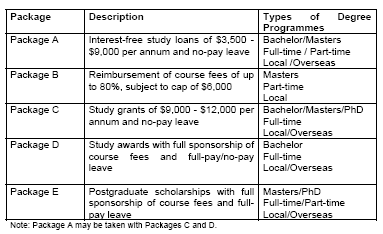
Up to 5 more teacher posts will be given to each of
the 28 school clusters to support schools with teachers who are
pursuing full-time postgraduate studies.
Non-graduate teachers who wish to upgrade their
qualifications while continuing to teach can now take up any
part-time on-campus degrees currently offered by the National
University of Singapore, Nanyang Technological University and SIM
University (UniSIM), instead of only 27 UniSIM part-time degrees in
teaching subjects currently. Upon completion of the course, teachers
can be considered for emplacement on the graduate salary scale if
they meet the other prevailing emplacement conditions.
Recognition and Rewards
MOE will be introducing a new Education Scheme of
Service (2008) from 1 April 2008 to better recognise and reward good
teachers. The new scheme will be more market responsive and there
will be a stronger link between pay and performance.
Officers will be placed on a salary range system
with merit increments that are based on one’s performance, potential
and market wage movements. This will replace the current salary
scale system with fixed annual increments. With the revision to the
salary ranges, a one-off salary increment of up to 4% will be made
to the salaries of eligible officers on the new scheme.
There will be higher performance bonuses and sharper
differentiation in payouts based on performance. Good performers can
receive up to 1.0 month more in performance bonus. Very good and
outstanding performers can receive 1.5 months and 2.25 months more.
Prior to the roll-out of the new scheme, a performance bonus top-up
will be given in Mar 2008. The quantum will be 1.25 months, 1.0
month and 0.5 month for outstanding, very good and good performers
respectively.
MOE will also enhance its long-term incentive plan –
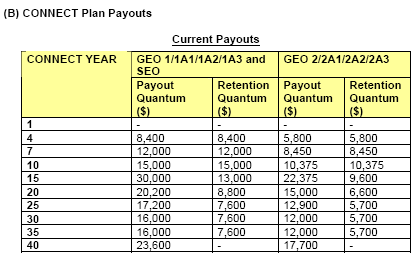
CONNECT Plan - for teachers. Under the current Plan, teachers
receive annual deposits throughout their career and are able to draw
out a proportion of the money every 3-5 years.
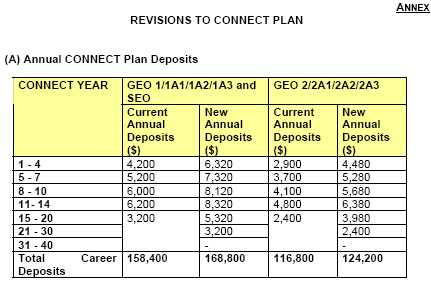
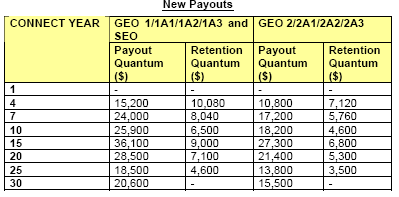
The total career deposits for CONNECT will be
increased by about 6%. The Plan will also be shortened from a
40-year to a 30-year plan. Education Officers can expect higher
payouts and look forward to drawing out their full CONNECT Plan
deposits earlier, at the end of 30 years of service (see Annex on
the revised CONNECT Plan deposits and payouts).
With the above changes, the annual package of good
performing teachers will be increased by up to 12%, while that for
better performers will be increased by up to 18%. For a classroom
teacher with 3 years of teaching experience on the General Education
Officer (GEO) 1A1 grade, the annual pay package will increase from
$52,000 to $58,000 for a good performer and from $55,000 to $65,000
for an outstanding performer. For an experienced Principal on the
Senior Education Officer (SEO) Superscale ‘H’, the annual pay
package will increase from $168,000 to $193,000 for a good performer
and from $185,000 to $218,000 for an outstanding performer.
Introduced in 2001, the Outstanding Contribution
Award (OCA) recognises significant contributions made by individual
staff and teams in schools. The current OCA amount given to each
school ranges from $3,000 to $10,000 a year, depending on the
school’s staff strength. The OCA will be increased by a flat rate of
$3,000 to enable schools to reward more individuals who have made
value-added contributions.
Opportunities for Career Development
The GROW Package provided more career options and
advancement opportunities for teachers on both the teaching and
leadership tracks. Under GROW 2.0, more career advancement and
development opportunities will be provided for teachers on the
Senior Specialist (SST) track. The SSTs are specialist Education
Officers who play a critical role in MOE HQ, bringing research in
the field to bear on educational policies and school programmes.
The number of SST posts in MOE HQ will be increased
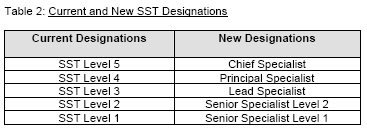
from 168 to 310. A new SST Level 5 position of Chief Specialist will
be created. The Chief Specialist will provide leadership to the
SSTs, harness research from both within and outside MOE and
translate key research findings into policies and school
initiatives. SST Levels 1-4 will also be redesignated to better
recognise their professional status.
Table 2 shows the current and new SST designations.
17. To enable SSTs to develop deep expertise in
their area of specialisation, MOE will set aside $1.5 million
annually to support the research projects by SSTs. We will also
allow SSTs to devote up to 20% of their time to research-related
work like presentation of papers at conferences, attachments at the
National Institute of Education and other research organisations,
attachments to clusters to conduct school-based research and
completion of doctoral research. SSTs can look forward to
opportunities for research attachments at NIE. A new milestone
training programme will also be developed for SSTs who demonstrate
the potential to assume a Lead Specialist position and higher.
In line with the Civil Service’s move to introduce
service-wide re-employment policies by 2010, MOE will take the lead
to provide further re-employment opportunities for Education
Officers beyond the age of 62. A re-employment framework will be
piloted from Jun 2008 over the next two years.
All Education Officers above 62 years old who are
physically fit to work and have good performance will be offered
re-employment as Contract Adjunct Teachers up to age 65. In
addition, school middle managers and officers holding equivalent
positions in MOE HQ may also be offered to continue in their
existing jobs subject to availability and individual needs of the
schools. School leaders and senior officers will be offered work on
a project or contract basis.
MOE will put in place a systematic process to help
officers make plans in good time for their retirement. This includes
providing a comprehensive list of jobs and assignments for officers
to consider, job matching and retirement planning seminars. We will
learn useful lessons from the 2-year pilot and review the
reemployment framework for Education Officers in 2010, in time to
roll-out a revised plan, in tandem with the roll-out of the Civil
Service-wide re-employment framework.
To develop, recognise and retain teachers with the
potential to assume key leaderships in the Education Service, MOE
will introduce a “Future Leaders Programme” (FLP). Officers on the
FLP will have opportunities for challenging assignments and
projects.
Well-Being for Our Teachers
The part-time teaching scheme (PTTS) currently
applies to confirmed classroom teachers who are married with
children under 12 years of age or those aged 55 years old and above.
The PTTS will now be extended to Heads of Departments, Subject
Heads, Level Heads and Senior Teachers in schools.
To provide further support to schools with part-time
teachers, up to 5 more teacher posts will now be provided to each
school cluster. The additional posts will be over and above the
existing manpower grants given to schools to buy services to fill
the remaining load of teachers on the PTTS, and the 5 additional
posts to support schools with teachers on full-time postgraduate
studies mentioned earlier.
MOE will also enhance the no-pay leave policies for
childcare. Currently, only female teachers can apply for no-pay
childcare leave up to the child’s 3rd birthday.
In support of the Government’s pro-family policies,
both male and female teachers can now apply for no-pay childcare
leave up to the child’s 4th birthday. Teachers can now accompany
their spouses who are sent on overseas posting or training for up to
four years on no-pay leave, instead of the current three years.
Summary
The initiatives under the GROW 2.0 Package are
summarised below.

Background
In September 2006, the Ministry of Education (MOE)
announced that it will be spending $250m over three years with the
introduction of the GROW package, for the professional
and personal Growth of Education Officers, through better
Recognition, Opportunities, and seeing to their Well-being.
The package had created more opportunities for teachers to develop
and strengthen their core competencies, provided more career options
and choices, and gave greater recognition to the everyday work of
teachers.
II. T HE PHILOSOPHY
FOR EDUCATIONAL LEADERSHIP
Quality leadership, at all levels, has been a key
strength in the success of the Singapore education system. Quality
school leadership is a strategic leverage point, in the wake of
faster change, greater diversity and complexity, and the increased
degree of autonomy and flexibility enjoyed by our schools.
It is therefore timely for a document setting out
the philosophy for educational leadership, to bring to sharper focus
the collective values of the fraternity of school leaders, so that
our schools continue to excel and do their best for their learners,
the community and Singapore.
The document, entitled “Anchored in Values and
Purpose”, represents the culmination of the work led by the
Educational Leadership Development Centre in MOE, in consultation
with the community of school leaders. The Document reflects what MOE
and schools collectively stand for, presenting a unity in core
beliefs even as we celebrate diversity across schools.
Guiding Principles
The Philosophy Document comprises four Guiding
Principles:
Principle 1
Educational Leadership is anchored in Values and
Purpose. This is the lead principle as it underscores the
development of our leadership efforts towards values-based
leadership. This belief underlies the purpose of Principalship: to
lead schools to provide our children with a well-rounded education.
Principle 2
Educational Leadership inspires all towards a Shared
Vision. The Principal set clear directions and ensures that the
vision is focused on student learning and development.
Principle 3
Educational Leadership is committed to Growing
People. The Principal values all staff as individuals and
professionals and looks into their development and growth by
building their capacity.
Principle 4
Educational Leadership Leads and Manages Change.
The Principal is prepared for future changes and always remains
innovative and improvement driven. His leadership builds on the
past, learns from the present and prepares for the future.
Background - Developing the Philosophy
The Philosophy Document was developed through a
rigorous process with input from Principals, MOE Divisions and best
practice studies of international and local institutions. Leadership
stories, anecdotes, observations and ideas were then distilled into
beliefs and principles that best represented the collective values
of the Principal fraternity in Singapore.
Ministry of Education
27 December 2007
Source:
www.moe.gov.sg Press Release 27
Dec 2007

|


 New pay and career package for
teachers
New pay and career package for
teachers

 All rights reserved


