|
Continued from
FrontPage of Article
Annex 1
Nan Hua Primary:
Integrated form classes comprising GEP and non-GEP pupils
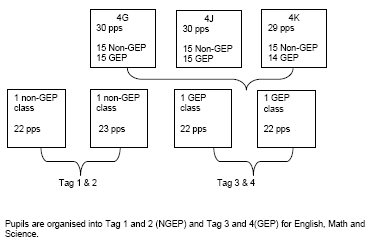
Nan Hua Primary (NHPS) had an enrolment of 44 P4 GEP
pupils in 2007. Instead of placing all 44 GEP pupils in two intact
classes of 22 each, NHPS combined the GEP pupils with 45 top
mainstream pupils, and created three integrated classes of 33 pupils
each. GEP pupils were pulled out during curriculum time for the
following subjects: English, Math, and Science. For Higher Chinese
and Social Studies, the three mixed classes were taught using the
GEP enriched curriculum. The remaining subjects including Physical
Education, Art & Crafts, Civics and Moral Education (CME), Music and
Individualized Research Study (IRS) were taught by the form
teachers. The classes were taught by GEP teachers, and GE-trained
mainstream teachers. In this model, GEP and mainstream pupils spent
50% of curriculum time together on a daily basis.
Tao Nan School:
GEP-BiCEP classes
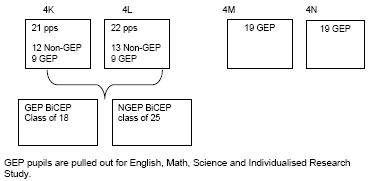
Tao Nan School (TNS) had an enrolment
of 56 P4 GEP pupils in 2007.
TNS used its pilot Bicultural Chinese
Elective Programme (BiCEP) to introduce its integration model.
Instead of being placed in intact GEP classes, 18 GEP pupils are
placed in 2 GEP-BiCEP classes, together with 24 high-ability
mainstream pupils who opted and qualified for the BiCEP. The 2 mixed
classes have a class size of 21 and 22 pupils respectively. The
other 38 GEP pupils are placed in GEP-only classes.
GEP pupils in the 2 GEP-BiCEP classes
are pulled out during curriculum time for English, Math, Science and
Individualised Research Study, in a class of 18. For other subjects,
GEP pupils remain in their combined GEP-BiCEP classes.
This means that the 18 GEP pupils in
the GEP-BiCEP classes spend about half of the curriculum time with
their non-GEP peers on a daily basis.
Annex 2
GEP Schools’ Plans for
2008
NAN
HUA PRIMARY SCHOOL (NHPS)
1. This year’s P4 pupils who were part of the pilot
programme (described in Annex 1) will proceed to P5 and continue
with the same arrangement. They will spend half of their curriculum
time in their mixed form classes. The school hopes to attract about
60 P4 GEP pupils next year. It will place the 60 pupils with the top
60 mainstream pupils to create 4 mixed classes, each with 30 pupils.
Parents of mainstream pupils will be given the choice to opt out.
The P4 pupils will also have 50 percent common curriculum time in
the form class, with GEP pupils pulled out only for English, Math
and Science.
TAO NAN SCHOOL (TNS)
2. For this year’s P4 BiCEP class progressing to P5,
the structure and arrangement would remain largely similar with only
a small modification. The school would pull GEP pupils out for
Social Studies lessons as well. As for 2008 P4 pupils, the school
plans to extend the integration model to the non-BiCEP GEP classes
as well. P4 GEP pupils will be given the choice to opt for BiCEP.
The arrangement and curriculum for the GEP-BiCEP model would be
similar to those for P5. GEP and mainstream pupils in these
integrated BiCEP classes spend about 44 percent of curriculum time
together on a daily basis, while the non-BiCEP integrated classes
pupils spend about 39 percent of curriculum time together. In
addition, pupils of each level will get to attend a 3-day 2-night
camp during the year, and perform at least eight hours community
service together on common projects.
ANGLO-CHINESE SCHOOL (ACS
[P])
3. This year, ACS(P) implemented integrated classes
for Chinese Language and Physical Education at P4. Based on positive
feedback from teachers, the school has decided to increase the
number of subjects that will be taught in integrated classes for
next year’s P4 and P5 pupils. Art and Music will also be taught in
integrated classes next year in addition to Chinese Language and
Physical Education. P4 GEP pupils will also be required to take up a
sports CCA in Term 1 next year. This would mean an additional hour
of interaction with mainstream boys in the sports arena each week.
CATHOLIC HIGH SCHOOL
(CHS)
4. CHS had also implemented its own integrated model
this year. Pupils in the 2 GEP classes had common Music, Art and
Crafts, Physical Education and Individualised Research Study lessons
with pupils in the top 2 mainstream classes. In 2008, the 3 P5 mixed
classes will continue with this arrangement. The incoming P4 pupils
will have even more common curriculum time as CHS plans to include
Civics and Moral Education and Higher Chinese in the ‘common’
curriculum as well. GEP pupils will stay in their own class only for
English, Math, Science and Social Studies. In addition to the
integrated classes, CHS also plans to have at least 2
school-wide activities
per term to ensure that GEP pupils have opportunities to interact
with non-GEP pupils of the other classes as well. These activities
will cover different domain areas ranging from gaming to
broadcasting to math and science trails.
HENRY PARK PRIMARY SCHOOL (HPPS)
5. From 2008, all P4 GEP
pupils will have common lessons with mainstream peers for Art and
Craft, Civics and Moral Education, Music and Physical Education.. In
addition, about twenty P4 GEP pupils offering Chinese Language will
be placed in integrated classes with 40 mainstream pupils. These
mixed classes will be organised based on Chinese Language ability
level. 2008 P5 and P6 pupils will also be with mainstream peers for
Art and Craft, Music and Physical Education lessons. The school will
also allow a very small number of non-GEP pupils who have
exceptional ability in Math to join GEP math classes.
NANYANG PRIMARY SCHOOL (NYPS)
6. NYPS will be
implementing integrated classes for incoming P4 pupils in 2008. It
expects to admit about 100 GEP pupils. These 100 pupils will be
placed in eight mixed classes with 160 top mainstream pupils, with
each mixed class size averaging 32 to 33 for all the subjects except
English, Math, Science and Social Science which will be taught in
separate GEP and mainstream classes. In the co-curricular realm, GEP
and mainstream pupils will work on joint Community Involvement
Projects and service learning projects. P5 GEP pupils will also
guide P1 and P2 Learning Support pupils in reading for two terms.
RAFFLES GIRLS’ SCHOOL (RGPS)
7. In RGPS, about 60-70
incoming P4 GEP girls will be placed in GEP classes for English,
Math, Science and Social Studies. For all the other subjects, they
will have common lessons in mixed classes with 80 top mainstream
girls. The Computer Enrichment Programme will also be extended to
non-GEP pupils. Beyond the formal curriculum, mainstream and GEP
girls will also attend house practice together for 15 weeks,
participate in two hours of CCA every week, and have common field
trips.
ROSYTH SCHOOL
8. Rosyth will implement
integrated classes for P4 and P5 from 2008 to increase the number of
contact hours for GEP and mainstream pupils. About 50 incoming P4
GEP pupils will be combined with 80 top mainstream pupils in mixed
classes for Art and Crafts, Music, Physical Education and Higher
Chinese/Chinese Language. All the other subjects will be taught in
their intact form classes. The P5 pupils will have common lessons
with mainstream peers for Art and Crafts, Music and Physical
Education. Pupils will also be working on common CIP projects and
attend overnight camps together.
ST HILDA’S PRIMARY SCHOOL (SHPS)
9. From 2008, both P4
and P5 GEP pupils will be placed with non-GEP pupils for certain
subjects. Pupils will remain in their own form classes for English,
Math, Science, Social Studies and Civics and Moral Education. GEP
pupils will join non-GEP pupils for Art & Crafts, Chinese Language
(for P4), Chinese Language/Higher Chinese (P5), Music, Physical
Education, and Individualised Research Study. For each grade level,
there are also co-curricular programmes like camps and Community
Involvement Project for mixed groups of pupils. The P5 Advanced
Enrichment Math Classes will also be open to eligible non-GEP
pupils.
Source:
www.moe.gov.sg Press Release 2 Nov
2007

|


 Promoting more interaction
between GEP and non-GEP pupils
Promoting more interaction
between GEP and non-GEP pupils

 All rights reserved


