|
Continued from
FrontPage
of Article

The
United States
tops the rankings of
The Global Information Technology Report
2005-2006’s “Networked Readiness
Index” for the third time in five years, maintaining its eminent
position as a leader in the area of innovation and confirming its
position as an information and communication technology powerhouse.
With record coverage of
115 economies worldwide and published for the fifth consecutive
year, The Global
Information Technology Report (GITR)
has grown into the world’s most respected assessment of the impact
of information and communication technology (ICT) on the development
process and the competitiveness of nations. The Networked Readiness
Index (NRI) measures the propensity for countries to leverage the
opportunities offered by ICT for development and increased
competitiveness. It also establishes a broad international framework
mapping out the enabling factors of such capacity.
The Report is produced by the World Economic Forum in cooperation
with INSEAD and is sponsored this year by Cisco Systems.
“Information and communication technologies presently represent one
of the most important drivers in boosting efficiency and
productivity in today’s fast changing global economy. The
United States has
been for many years an ICT powerhouse, and its sustained ability to
harness these technologies so effectively for boosting the
efficiency of its economy and its many markets provides a standard
of measurement for other countries wishing to rapidly improve the
living standards of their citizens. The long pipeline of scientific
and technological innovation is a remarkable source of strength for
the US economy which, large macroeconomic imbalances
notwithstanding, remains a choice destination for foreign capital,”
said Augusto Lopez-Claros, Director of the Global Competitiveness
Network at the World Economic Forum and co-editor of the Report.
“The Global Information Technology
Report series represents the result of
a collaborative research effort, and over the years has become a
powerful tool for governments, businesses and civil societies to
assess the extent to which information and communication
technologies are being used by economies to better leverage the
development process. It also permits us to benchmark the performance
of each economy against more than 100 other nations, and highlight
best practices and policies,” said Professor Klaus Schwab, Founder
and Executive Chairman of the World Economic Forum.
Under the theme “Leveraging ICT for development”,
The Global Information Technology Report
appears at a critical time for the global economy: a mood of
cautious optimism about the short-term outlook is tempered by
growing concern about other less auspicious trends, from the
possible repercussions of global macroeconomic imbalances to the
impact of rising income disparities. However, ICT is clearly
emerging as one of the key drivers of economic growth and
competitiveness. In line with the World Economic Forum’s sustained
efforts to expand the geographical coverage of the Report, this year
11 new countries from diverse regions of the world (mainly Eurasia,
Asia and Africa) have been included in the sample.
“Networking and communication technologies are enhancing the way
people communicate and exchange ideas, opening the next horizon for
creativity, innovation, growth and competitive advantage. The strong
link between the Networked Readiness Index and global
competitiveness has increased and is evidence of the critical role
that these technologies play in any economy or company's strategic
plans. The GITR will provide all of us with greater insight and help
to guide our future decisions," said John Chambers, President and
CEO of Cisco Systems.
The Networked Readiness Index examines an economy’s ICT condition on
three dimensions: the general macroeconomic, regulatory and
infrastructure environment
for ICT; the
readiness of the three key
stakeholders ⺷ individuals, businesses and governments ⺷ to use and
benefit from ICT; and their actual
usage of the latest information and
communication technologies.
Soumitra Dutta, Professor of Business and Technology and Dean of
Executive Education at INSEAD, explained: “The Networked Readiness
Index (NRI) has become a globally accepted benchmark of an economy's
participation in the networked economy. The NRI provides a useful
indicator to decision leaders from the private and public sectors
about the role of technology in driving the competitiveness and
productivity of nations.”
Highlights of the Results of the
Networked Readiness Index Rankings 2005-2006
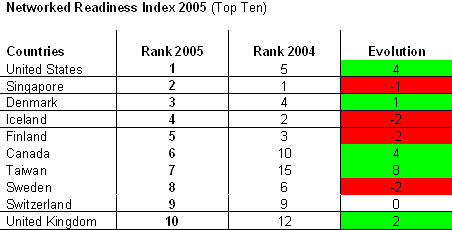
· The United States
regains the top position in the rankings,
reflecting an impressive performance in the areas of ICT physical
infrastructure, a broadly supportive market environment and high
levels of business and government usage of the latest technologies.
The United States continues to lead the world in technological
innovation, helped by the excellent quality of its higher education
institutions and extensive levels of cooperation between its
research bodies and the business community. The United States also
stands out for the ready availability of venture capital – key for
start-ups to develop and prosper in what can be a risky sector. Also
noteworthy is the prominent role assumed by the private sector in
research and development as well as cooperation with the public
sector in innovation and ICT penetration. Indeed, 17 of the 36 World
Economic Forum Technology Pioneers 2006 (www.weforum.org/techpioneers)
come from the United States.
· Singapore,
in second place overall, maintains its commanding position having
achieved a top-three ranking for the fourth consecutive year.
Singapore has an excellent regulatory environment, world-class
levels of education and training, and a government that is committed
to enhancing the use of the latest technologies across all sectors
of the economy – all in a context of excellent macroeconomic
management and persistent efforts to improve the institutional
environment for economic activity.
· Nordic countries maintain their positions at the top of the
rankings, with Denmark,
Iceland,
Finland
and Sweden
in third, fourth, fifth and eighth places respectively. Nordic
countries have registered consistently high ICT penetration rates
and have occupied places in the top ten positions over the last five
years. Their high rankings reflect the same set of factors that have
propelled these economies to the top of the world competitiveness
league. These factors include highly developed educational
institutions which have fostered a strong culture of innovation;
transparency in government which has contributed to the emergence of
a friendly climate for new business ventures; and a strong
predisposition to adopt the latest technologies, in government, the
business community and civil society.
· Asia and the Pacific also do extremely well this year with
Taiwan,
Hong Kong,
Korea,
Australia
and Japan
occupying ranks 7, 11, 14, 15 and 16, respectively.
India broadly
maintains its position with respect to last year (at 40th place)
while China
drops 9 positions to 50th place, widening the performance gap with
respect to India. Especially noteworthy is the showing of Taiwan,
gaining 8 positions from last year and entering in the top ten for
the first time. The rise of Taiwan as an ICT powerhouse in the last
three decades, as a result of intelligent public policies and
public-private synergies in the ICT sector, is indeed exceptional
and is the object of a specific case study included in the Report
this year.
· Estonia
leads the eastern European countries with a rank of 23 out of 115
(gaining two positions from last year), thanks to its excellent
political and regulatory framework for ICT.
· The highest ranking Latin American countries are
Chile (29),
Brazil (52) and
Mexico
(55). Compared with last year’s generalized decreasing trend, the
region displays a more varied performance this year, with several
countries markedly improving their positions, notably Chile (up 6),
Mexico (up 5), El Salvador
(up 11), Colombia
(up 4) and Argentina
(up 5). This encouraging development is unfortunately accompanied by
a further slide of countries such as Brazil (down 6),
Costa Rica (down 8)
and Guatemala
(down 10).
· Although South Africa
drops three positions from 34 last year to 37 this year, the country
leads sub-Saharan Africa in terms of networked readiness.
Mauritius (ranked
45) and Botswana
(ranked 56) follow South Africa. While Mauritius has improved its
performance by two positions, Botswana has dropped six positions
from last year.
· In other markets, Israel
remains the top performer in the Middle East. Posting a rank of 19
overall, Israel shows excellent scores in areas such as
technological sophistication, the quality of scientific research
institutions, the availability of venture capital, cellular
telephones and the latest technologies. Given Israel’s excellent ICT
performance, this year’s Report includes a case study exploring the
role government policies had in the development of a first-class ICT
industry in the country. The United
Arab Emirates (UAE) is the top
performer in the Gulf region, with a rank of 28.
Tunisia, in
position 36, has the highest ranking in North Africa.
The Global Information Technology
Report 2005-2006 consists of five main
parts: the first three contain essays written by practitioners,
scholars and experts with relevant knowledge and experience in the
ICT area. An update of the Networked Readiness Index is followed by
chapters on issues related to networked readiness,
productivity-related topics and reports on the varied state of ICT
development in Chile, Israel, Korea, Mexico and Taiwan. The fourth
part comprises 115 detailed country profiles, providing a snapshot
of each economy’s level of ICT penetration and usage; and the fifth
part consists of data tables with country rankings for each variable
used in calculating the Index.
The editors of the Report
are Soumitra Dutta of INSEAD and Augusto Lopez-Claros and Irene Mia
of the World Economic Forum.
Source:
www.weforum.org Press Release
28 Mar 2006
|


 Singapore takes second place in WEF's Global IT Report

 All rights reserved


