|
Continued from
FrontPage
of Article
THE HOTELS AND
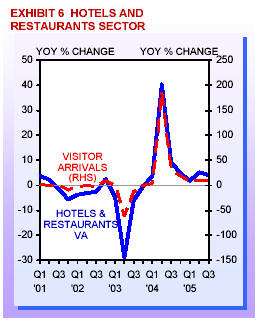
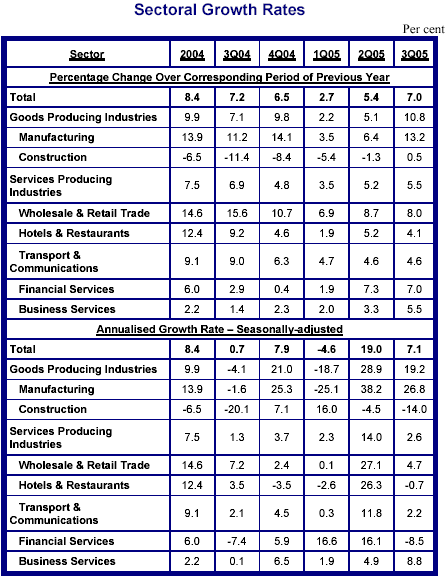
RESTAURANTS SECTOR registered a 4.1% gain in 3Q05, compared to
5.2% in 2Q05. Steady gains in this sector reflected the continuing
strength in visitor arrivals, which rose by 8.4% in the quarter.
This bolstered occupancy rates and room revenues for hotels.
Restaurants too enjoyed a moderate increase in sales in the quarter.
GROWTH IN THE
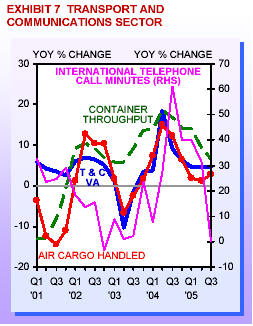
TRANSPORT AND COMMUNICATIONS SECTOR remained at 4.6% in 3Q05,
unchanged from the previous quarter. While most segments reported
stronger growth, decelerating growth in water transport and storage
services offset these gains. The air segment saw faster growth in
air cargo volumes, but a slower increase in air passenger volume.
Meanwhile, growth of the communications segment strengthened on
steady gains in both broadband and mobile phone subscriptions.
THE FINANCIAL
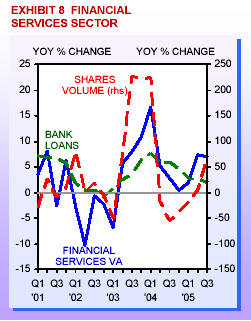
SERVICES SECTOR expanded by 7.0% in 3Q05, just a shade off the
7.3% gain a quarter earlier. During the quarter, most business
segments did better. Activity in the stock broking and fund
management segments, in particular, rose sharply compared to 2Q05.
THE BUSINESS SERVICES
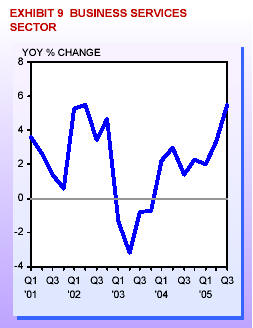
SECTOR expanded by 5.5% in 3Q05, up from 3.3% a quarter earlier.
The improvement in the sector was driven by stronger gains in the
real estate segment. Business in the segment benefited from the
strong turnaround in sentiments in recent months. Most other
business segments also registered stronger growth. Growth in the IT
services and business representative offices segments, however,
moderated slightly from relatively high rates in the previous
quarter.
Labour Market
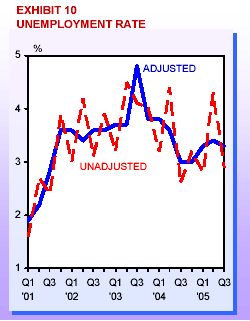
Total employment rose by
28,700 in 3Q05, compared with 31,700 in the previous quarter. All
major industry segments registered gains, with the services segment
continuing to account for much of the increase. During the quarter,
the number of services jobs rose by 18,400. In manufacturing and
construction, the respective gains were 8,000 and 2,300.
Retrenchment, however, also rose to 2,500 from 2,116 in 2Q05 as
restructuring in the manufacturing sector hastened. The growth in
employment led to the easing of seasonally adjusted unemployment
rate to 3.3%, from 3.4% in 2Q05.
Labour Productivity
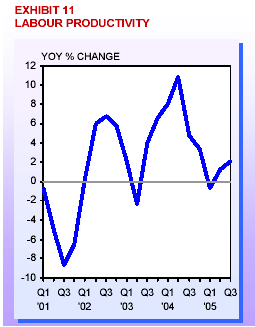
Stronger GDP growth in
3Q05 lifted labour productivity by 2.1% in the quarter, compared
with a 1.2% gain a quarter earlier. The manufacturing and wholesale
& retail trade sectors saw the largest improvement of 6.2% and 3.8%
respectively. Smaller gains were seen in the transport &
communications (1.9%) and hotels & restaurants (0.9%) sectors. The
construction, financial services as well as the business services
sectors, saw declines in labour productivity.
Business Costs
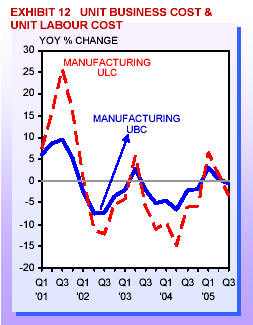
The overall unit labour
cost (ULC) index rose for the fourth consecutive quarter. ULC went
up by a slower 0.8% in 3Q05, compared to the 1.3% increase in the
previous quarter. The unit business cost (UBC) index of
manufacturing fell 0.7% in 3Q05, after posting 0.5% growth in the
earlier quarter. The decline was mainly due to lower manufacturing
unit labour costs. The robust growth in manufacturing output in 3Q05
had led to a 3.3% drop in manufacturing ULC, compared to the 1.6%
increase a quarter earlier. On the other hand, services cost
increased 0.6% on account of higher costs of utilities and rents.
External Trade
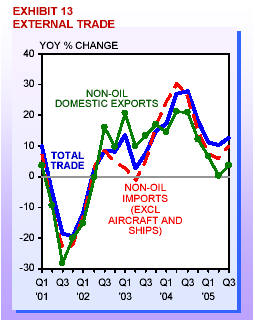
Singapore’s external
trade expanded by 13% in 3Q05 to improve on the 10% pace set a
quarter earlier. Total exportsin the three-month period grew at
13%,also higher than the 10% in 2Q05. Both domestic exports and
re-exports registered stronger growth. In particular, NODX grew by
3.6%, up from 0.3% in 2Q05. Growth of non-oil imports (excluding
aircraft and ships) also accelerated to 10%, from 5.9% in 2Q05. In
volume terms, total trade increased by 9.1%, up from 7.2% gain in
the previous quarter.
Investment
Commitments
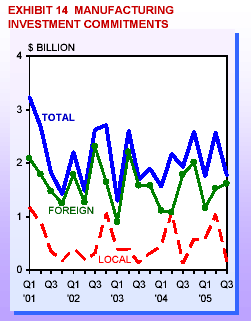
In 3Q05, manufacturing
investment commitments totalled $1.8 billion in terms of fixed
assets. When the commitments are fully operational, they would
create a value added of $1.6 billion and generate about 2,200 jobs.
54% would be for skilled workers. Investment commitments in services
promoted by EDB in the third quarter of 2005 amounted to $391
million in total business spending. When these commitments are
realised, they will generate a value added of close to $700 million
and create about 1,800 jobs of which 78% are for skilled workers.
Balance of Payments
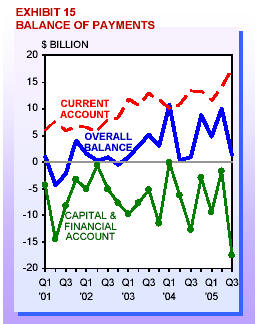
Singapore’s overall
balance of payments registered a smaller surplus of $1.3 billion in
3Q05, compared with $10 billion in 2Q05. This reflected the increase
in net outflow from the capital and financial account, even as the
current account recorded a larger surplus. The current account
balance in the quarter reached $17 billion, up from $14 billion a
quarter earlier. Net outflow from the capital and financial account
surged to $18 billion, from $1.7 billion in 2Q05. Mirroring these
developments, Singapore’s official foreign reserves in the quarter
rose to $196 billion, equivalent to 7.8 months of current imports.
Consumer Price
Inflation
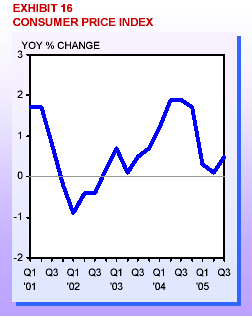
The CPI rose by 0.5%
year-on-year in 3Q05, rising from 0.1% in the second quarter. Much
of the increase was accounted for by higher electricity tariff and
petrol prices. Nevertheless, lower car prices helped to keep
consumer price inflation at a relatively low rate. The impact of the
cut in foreign maid levy also continues to be reflected in the
consumer price index in the quarter.
Outlook for 2005 and 2006
The slowdown in economic growth early this year has
been more than reversed by the strength of the rebound in 2Q05 and
3Q05. This resurgence – led by manufacturing, financial services and
entrepot trade – mirrored the improvement in the global economy.
This favourable growth trend looks likely to be
sustained in the remaining months of the year. Despite the
disruptions of severe weather conditions (particularly to the oil
and natural gas industries), growth in the US is expected to remain
healthy. Easing inventory problems in the global electronics
industry is also expected to spur electronics production in
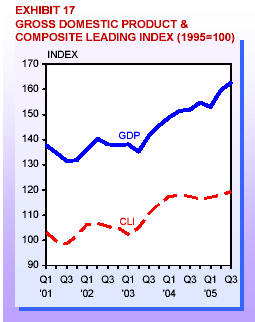
Singapore. A similar outlook is suggested by the composite leading
index for 3Q05, which registered the largest quarterly gain since
1Q04.
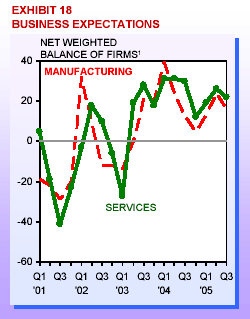
The latest business expectations survey continues to
show positive sentiments in all major industry segments.
Nevertheless, reflecting the strong gains already made in the past
half a year or so, this optimism has been tempered with some
caution.
For 2006, Singapore should be able to achieve its
medium term growth potential as outlook for global economy and
electronics industry remains sanguine. Growth rates in both the
developed and East Asian developing economies are forecasted to be
little changed from 2005. Global semiconductor sales growth is
expected to pick up pace in 2006. This would give a boost to
manufacturing and trade-related activities in Singapore. The
improvements in labour market conditions and the low inflationary
environment should also lift domestic demand further.
Nevertheless, risks to economic growth remain.
Limited spare capacities in the global oil industry meant that
supply disruptions would continue to send prices northwards. In the
face of rising inflation, tightening monetary conditions in the
developed economies could dampen real estate prices, which would
remove an important support for consumer demand in these economies.
Finally, should the avian flu outbreak escalate into a pandemic, it
could severely disrupt economic activities worldwide.
In view of the above considerations, the Ministry of
Trade and Industry has raised the 2005 GDP growth forecast to around
5.0%. The forecast for economic growth in 2006 is between 3.0% and
5.0%.
Annex
Source: Singapore Department of Statistics
Source:
www.mti.gov.sg Press Release 17 Nov
2005
|


 Performance
of Singapore Economy in 3rd Quarter 2005
Performance
of Singapore Economy in 3rd Quarter 2005

 All rights reserved


