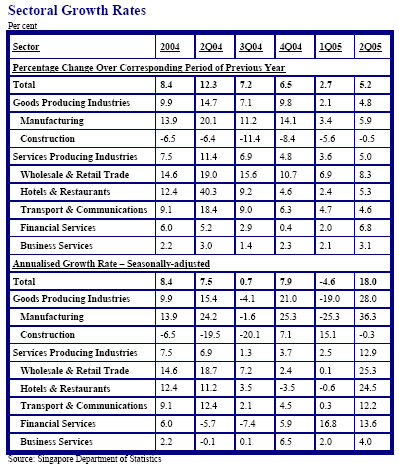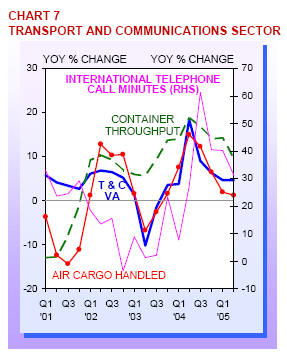
Growth In The Transport & Communications Sector clocked 4.6% in
2Q05, almost similar to the 4.7% for the previous quarter. The air
segment saw faster growth as a result of an increase in air
passenger volume. Meanwhile, the sea segment saw a moderation in
growth as container throughput and sea cargo grew at a slower rate.
Performance of the communications segment was dragged down by the
slowdown in international telephone call duration. The growth of
broadband and mobile phone subscribers, however, held steady.
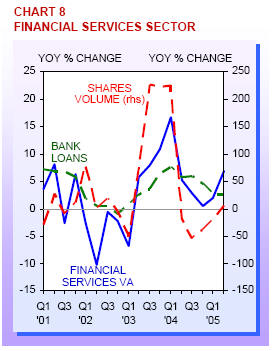
Financial Services expanded by 6.8% in 2Q05, faster than the 2.0%
growth in 1Q05. With the exception of FOREX trading, growth in all
major financial services segment improved. Growth in Asian currency
units and fund management helped drive the sector. Commercial banks,
insurance activity and stock, shares and bond brokerage also
registered a better showing this quarter.
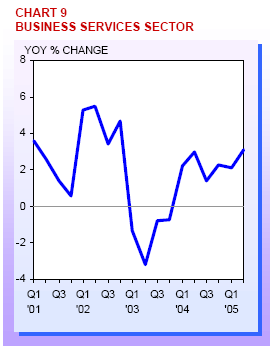
The Business Services Sector grew by 3.1% in 2Q05, a pick-up from
the 2.1% gain in 1Q05. The expansion in the sector was driven by
continued robust performance in the business representative offices
and IT & related services. The legal and accounting segments also
grew above the sector average. Real estate activity was flat.
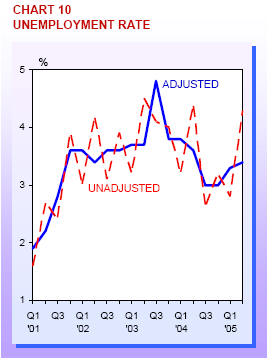
Labour Market
Total employment rose by 27,700 in 2Q05, larger than the 17,800
gained in the previous quarter. Both the manufacturing and services
sectors registered strong employment gains of 8,900 and 15,200
respectively. Construction employment also rose by 3,400. In 2Q05,
1,900 workers were retrenched, 12% less than in the previous
quarter. The seasonally adjusted unemployment rate rose marginally
to 3.4%.
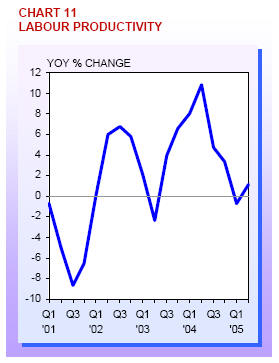
Labour Productivity Higher output growth in 2Q05 lifted labour
productivity by 1.1% in the quarter, compared with a 0.7% fall in
1Q05. Improvements were seen in industries such as wholesale &
retail trade (4.8%), transport & communications (2.3%), as well as
hotels & restaurants (2.2%).
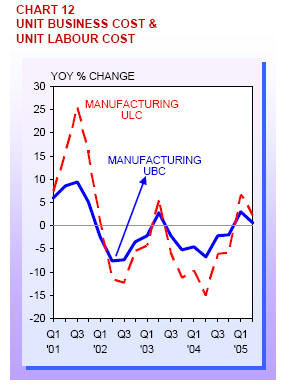
Business Costs
The overall unit labour cost (ULC) index inched upwards by 1.3% in
2Q05, a slower increase than the 3.5% in 1Q05. The unit business
cost index (UBC) of manufacturing crept up 0.7% in 2Q05. This was
due mainly to higher unit labour costs.
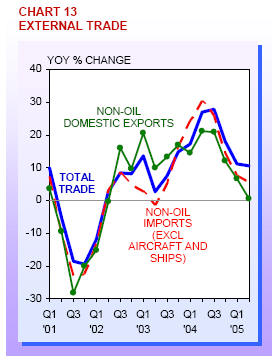
External Trade
Singapore’s external trade expanded by 10.5% in 2Q05, marginally off
the 11.3% pace set in 1Q05. Similarly, total exports grew at 10.5%
in the quarter, compared with 10.7% in 1Q05. Both domestic exports
and re-exports helped to sustain growth. However, NODX grew by 0.6%,
slower than the 6.8% in 1Q05. Non-oil imports (excluding aircraft
and ships) expanded at a slower rate of 5.9%, from 7.6% in 1Q05. In
volume terms, total trade increased by 7.3%, after 10.4% rise a
quarter earlier.
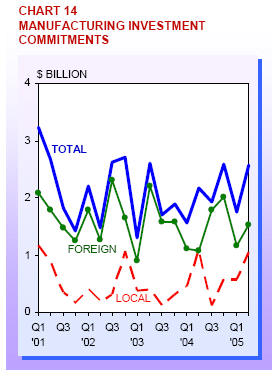
Investment Commitments
In 2Q05, manufacturing investment commitments totalled $2.6 billion
in terms of fixed assets. When realised, these investments would
create a value added of $2.2 billion and generate almost 6,300 jobs
of which 40.0% are for skilled workers. Investment commitments in
services promoted by EDB in the second quarter of 2005 amounted to
$832.9 million in total business spending. On realisation, these
investments will generate a value added of $1.6 billion and create
about 2,400 jobs of which 95.1% are meant for skilled professionals.
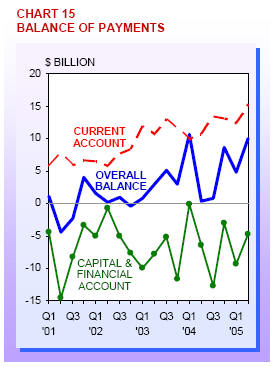
Balance of Payments
The surplus in Singapore’s overall balance of payments reached $10.0
billion in 2Q05, as a result of the decline in outflows from the
capital and financial account, as well as the improvement in the
current account surplus. The current account balance turned in a
larger surplus of $15.3 billion in 2Q05, largely due to an increase
in the goods account surplus. Against this backdrop, Singapore’s
official foreign reserves rose to $195.4 billion, equivalent to 8.0
months of current imports.
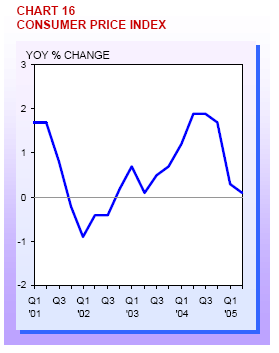
Consumer Price Inflation
The CPI rose by 0.1% in 2Q05, easing from 0.3% in the earlier
quarter. Lower housing costs contributed towards much of the
decline. Costs of education went up because of the increase in
tuition fees paid to foreign universities. An increase in the price
of recreation was largely accounted for by dearer cigarettes and
holiday travel. Transport and communications cost continued to trend
lower because of a significant decline in car prices.
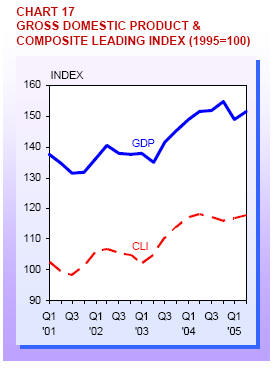
Outlook for 2005
In the first half of 2005, the Singapore economy
grew by 4.0% due to a better performance in the second quarter.
Higher second quarter growth was attributed to an expansion of
biomedical output and robust performance in key services sectors
such as wholesale & retail trade and financial services.
Moving forward, the outlook in the second half of
the year has improved. Continued growth in the G-3 economies, a
tentative recovery in the global electronics industry, limited
impact from higher oil prices and stronger domestic forward looking
indicators, together signal better prospects in the next six months.
Expectations of US economic performance in the
second half of 2005 remain optimistic on the back of healthy
expansions registered in the first two quarters. Meanwhile,
prospects for the Japanese economy in 2005 have improved. Growth in
the first quarter improved after nine months of marginal or negative
growth. This optimism was reinforced more recently by positive
readings from the June Tankan business confidence survey. In
comparison, prospects in the EU are more modest due to weak domestic
demand and a strong Euro.
In the global electronics industry, there are
tentative signs of a recovery. On the supply side, semiconductor
vendors have reduced inventories and exercised restraint in capital
spending. Meanwhile, demand for semiconductor chips is expected to
pick up in the second half of the year, particularly in niche areas
such as consumer electronics and info-communications products.
Although the pace of recovery may turn out to be slower compared to
previous electronics cycles, an improvement is still expected in the
second half of the year.
Oil prices are likely to remain high in the near
future, but its impact is expected to be tempered. Unlike the oil
shocks of the 1970s and the 1980s, which were the result of abrupt
supply disruptions, current high oil prices are due to strong growth
in two of Singapore抯 major export markets ?the US and China. As long
as high oil prices are the result of strong demand, the impact on
Singapore抯 economic growth should be limited.
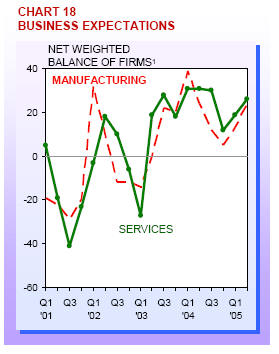
1 The y-axis of the chart on business expectations
represents the net weighted balance of companies that predict an
improvement in business situation. This is derived from the weighted
percentage of companies in the survey that predict better business
minus the weighted percentage of companies that predict worse
business.
Stronger domestic forward-looking indicators suggest that growth
momentum would continue for the rest of this year. The latest
business expectations survey reveals that sentiments in both the
manufacturing and services have improved. In view of the improved
outlook, the Ministry of Trade & Industry has narrowed the 2005 GDP
growth forecast to 3.5-4.5 per cent.


 Previous FrontPage Edition 11 Aug
2005
Previous FrontPage Edition 11 Aug
2005